Dorian Fitzgerald
Meghalayan
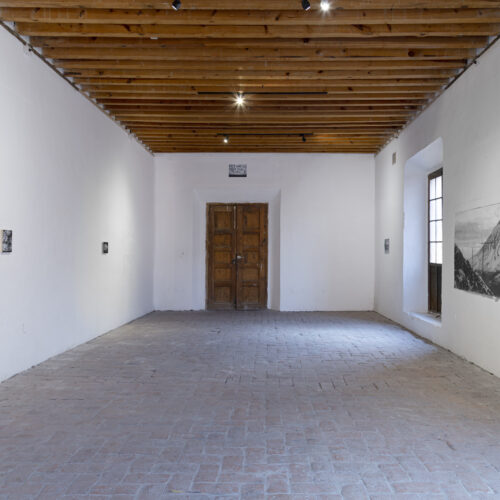
Del 9 de Mayo al 9 de Agosto, 2026
Museo de la Ciudad de Querétaro, Qro., México

Text by Enrique Giner
In the mid-20s—of the last century—Aby Warburg conceived the Mnemosyne Atlas: a constellation of images arranged on movable panels, fixed with tacks that allowed for their constant rearrangement. Reproductions of classical works coexisted with newspaper clippings, astronomical diagrams, and fragments of his own time. In that seemingly chaotic gesture, another way of thinking history was being rehearsed: not as a line, but as a field of forces in which images, by changing place, transform their meaning. Mnemosyne, daughter of Uranus and Gaia, here embodied memory, the origin of the arts, poetry, and knowledge.
This combinatory logic finds a precise echo in the so-called Kuleshov effect, formulated by the Russian filmmaker Lev Kuleshov: the same face acquires different meanings depending on the image that accompanies it. A bowl of soup, a girl in a coffin, or a woman reclining on a divan could profoundly alter its reading. Narrative does not reside in an isolated image, but in the relation between them; it is in that intersection that meaning is constructed.
Dorian FitzGerald’s work inscribes itself within this tradition of displacements and rereadings. His practice begins with a voracious accumulation of images drawn from magazines, books, personal archives, and fragmented memories. From an early age, the figure of the scientist David Suzuki and his series The Nature of Things introduced in the artist an early awareness of ecological imbalance and political inaction, a position then perceived as alarmist. That tension between warning and fascination filters through his work as a persistent layer.
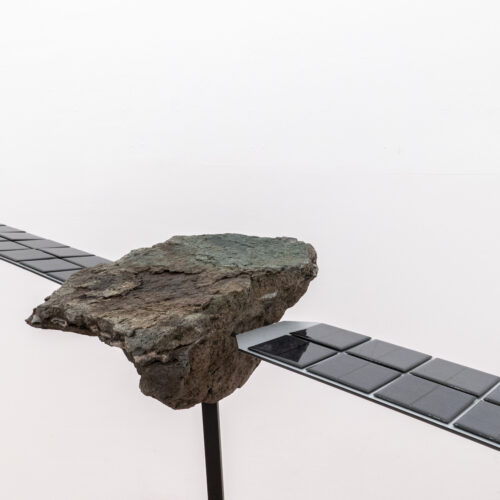
To this intimate archive are added images of striking beauty from diverse origins: magazines, volcanic phenomena, meteorite impacts. The eruption of Mount St. Helens in 1980, seen on the cover of National Geographic, settles as a foundational image: an almost incomprehensible force, thousands of times more powerful than the Hiroshima bomb, of unsettling beauty. Geological forces that exceed the human and become objects of fascination.
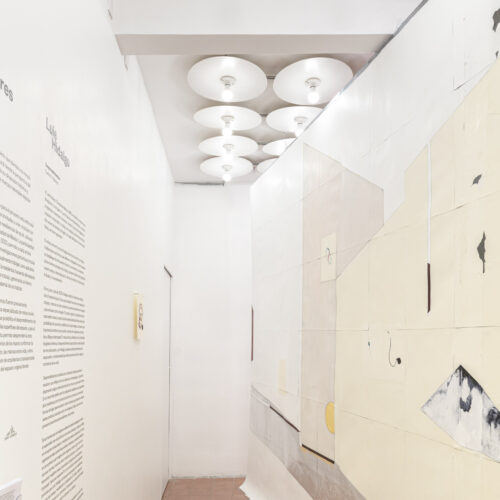
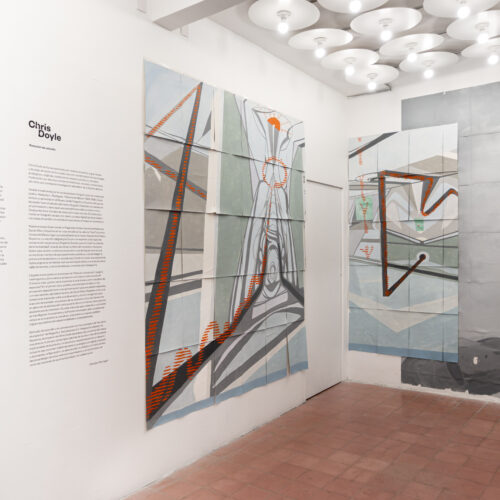
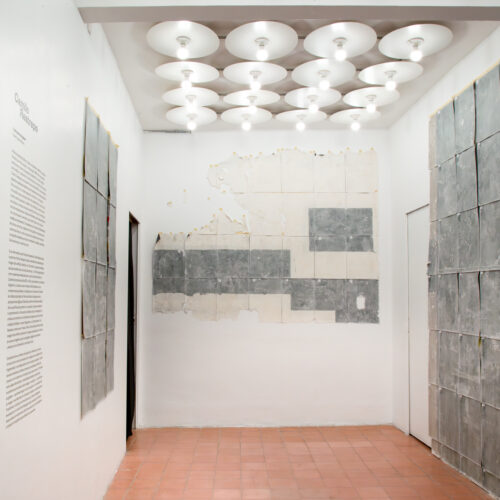
FitzGerald articulates these references through an almost encyclopedic logic. His paintings operate as processes of translation: images that sediment, distort, and reappear in layers, generating a constant friction between accident and ornament, between critique and desire.
At that intersection, his work takes shape as a personal atlas where memory, history, and the seemingly banal coexist without hierarchies. It also opens a reflection on our time, marked both by the Meghalayan and by the persistent idea of the Anthropocene, while his fascination with devotional objects and forms of luxury introduces an inevitable contradiction.
Dorian Fitzgerald was born in Toronto in 1975 where he lives and works, and holds a BA in Art and Art History from the University of Toronto and Sheridan College. His paintings, often monumental, depict the follies and indulgences of the wealthy using an idiosyncratic technique he has been refining for several years.His work has been exhibited at the Art Gallery of Hamilton, the Blackwood Gallery, University of Toronto Mississauga; the Montreal Museum of Fine Arts; the Galerie de L’Université du Québec à Montréal and the Museum of Contemporary Canadian Art (now MoCA), Toronto among others. His work is held in several public and private collections including the Montreal Museum of Fine Arts, the Art Gallery of Hamilton and the Donald Sobey Collection.